
In 2023 I was running portfolio sprints for other designers with a portfolio I hadn’t finished.
Design Garden
Helping designers ship the project they keep putting off, with a partner and a deadline.
- Role
- Founder. Product, design, and the app. I run every crew.
- Built with
- React and Supabase, with Claude Code as my build partner
- Timeline
- Spring 2025 to now (app built from Jan 2026)
- Status
- Live
- crews
- 4crews
- weekly check ins
- 80%*weekly check ins
- survey respondents said they wouldn’t have gotten this far without it
- 8 of 8**survey respondents said they wouldn’t have gotten this far without it
* Of all the weekly check ins pairs were scheduled to do, 80% happened in the app.
** 8 survey respondents, summer 2026.
“The accountability from deadlines was huge. I accomplished a lot more than I thought I could. I have two young kids and a full-time job.”
TL;DR
Most designers know what they should be working on. They’re just doing it alone, at night, after a day job. Design Garden gives them one partner, four weeks, a weekly check in, and a showcase night at the end. I designed it, built it, and I run it.
01 What I owned
One program, one score, one app
- 01The program: four week sprints, the schedule, showcase night, 4 crews so far
- 02The matching: six signals scored in code, then a live speed round
- 03The app: designed and built by me, with AI as my build partner
02 Where it started
I was the part that didn’t scale
Miami, 2023
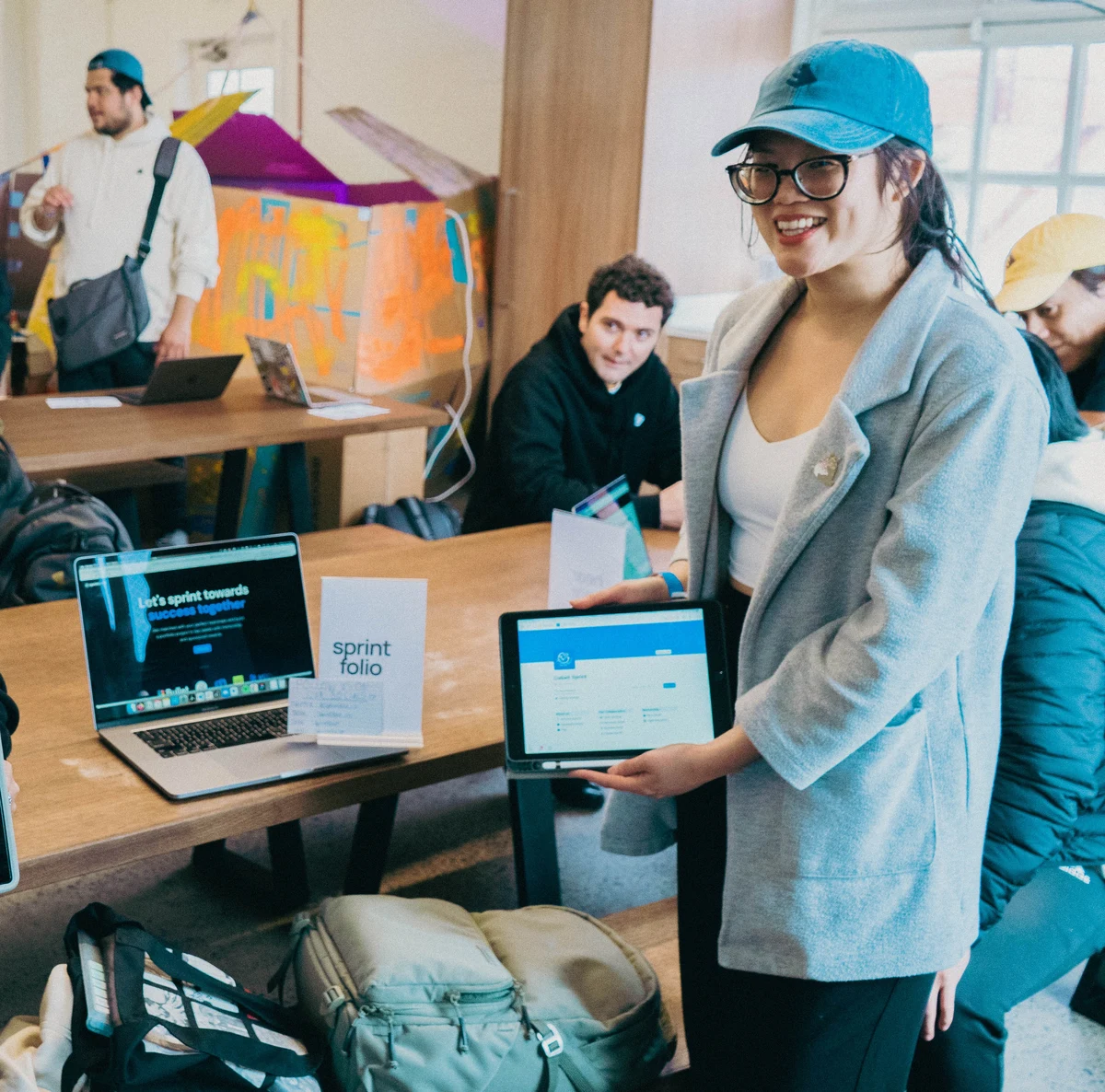
I met cofounders Angie Gonzalez and Rebeca Kaplan at Miami Hack Week. We were fresh UX bootcamp grads with no “real world” case studies, tired of applying to endless jobs. So we became the main characters of our own problem statement. We joined Buildspace, and that turned into Sprintfolio (opens in a new tab): two week sprints for designers like us.
San Francisco, summer 2023
Out of 5,400 projects, Buildspace (opens in a new tab) picked 35 for its first SF class. Sprintfolio was one of them.
Every season after
Our community ran 250+ sprint teams. It worked, and I was the part that didn’t scale. Every season meant 6+ hours in a spreadsheet, pairing people by hand.
03 Matching
Six hours in a spreadsheet became six signals in code
I moved matching into code. Every possible pair gets a score on six things: goals, experience, skills, discipline, timezone, and how each person gives and wants feedback.
Skills was the interesting one. Partners don’t work on the same project, and two people with the same skills don’t teach each other much. So the score peaks at about 25 to 50% overlap, not 100%.
Then the summer 2026 surveys said people wanted to meet before committing. The live workflow swap mid sprint already gave people a boost, so I added a speed round before pairs lock. Now the code makes the shortlist and the designers make the pick.
“I enjoyed the breakout rooms last night. I’d say they could even be 10 minutes just for the ability to meet more people.”

Robin Smith
Product designer moving into design systems. Looking for a partner who keeps a weekly deadline.
Goal:
Add a new case studyTap to see the score
04 The garden
Every check in plants something
A task list only grows. Nobody prunes it, and it feels like homework. I wanted check ins to be a two player mode, so every pair shares a whimsy garden. Each check in plants something. By week four, the pair can see what they built together.
“I did not expect that our chats would be more like solo builder therapy sessions.”
- Warm-up
- Wins
- Obstacles
- Takeaway
Just talk, nothing to type yet.
What surprised you this week?
What’s one thing you’re proud of that isn’t on your task list?
Take turns sharing your screen so your partner can see what you shipped this week.





- The garden is smaller and the question card gets about half the screen. Questions are bigger and both answers have room. The garden still sits beside it, so you watch your plant grow as you share.
- The card says who leads. Only the leader moves you both to the next step, and only after you both share. An info button explains the role when you need it and stays out of the way when you don’t.
- At the last step, your task list takes the garden’s place, so you plan next week with your tasks right there.
05 Showcase night
8 of 8 said they wouldn’t have gotten this far without it
After summer 2026, all 8 designers who answered the survey said their project wouldn’t have gotten as far without Design Garden. One of them put it like this:
“I whipped up a quick website instead of a portfolio... and landed a paid project with a startup the next day.”
06 What’s next
It works. Now it gets a proper design pass.
Since January, I built for function: make it work and get real crews using it. Now I’m giving Design Garden a proper design pass. The check in and the garden went first, and the before and after above shows what changed. The rest of the app is next.
07 Reflection
The part I’m not handing to the code
Sprintfolio ran on me. In 2023, AI couldn’t read a spreadsheet, so I paired people by hand and waited for the tools to catch up. I watched self serve products make money and kept ours low cost, since access was the mission. It wore me down.
What I believe now: cheap made it too easy to skip. Fall 2026 is $50, and I’m watching whether paying turns into showing up. And the more AI can do, the more people miss building next to each other. That’s the part I’m not handing to the code.